Pengikut

Diberdayakan oleh Blogger.
RSS

Black Truffle Farms


This item was sent to me after my item on the unusual sexual aspects of the truffle fungi.  It informs us that the industry is obviously thriving and is been built out hugely.  We may live to see an ample supply of product.

When you must wait several years for a crop, supply expansion must be slow.  However, a warning is in order.  I do not know what the yield may be twenty years later.   If it is related to the root mass of the trees then we are looking at a production explosion as the trees mature.

We should experience a true surplus of product developing in the next decade with falling prices.

I suspect that this product could well find its way into every pantry before it is a one deal.

Just about every farmer in the right climatic conditions (40N to 47N or most of the USA) can easily augment his wood lot with an acre or two of the appropriate trees.  It justifies actually cleaning the wood lot up properly and thinning out weed trees and over growth.

Black Truffle Farms


So you heard that a black truffle farm can be economically rewarding? Done correctly, a black truffle farm is the most lucrative legal cash crop that exists. Governments do not like competition in their illegal world wide drug trade. But, dont expect fast results or spend your future earninsg too quickly. A black truffle farm can take years before it starts to produce a single black truffle. Here in Spain though, black truffles can usually be collected / harvested 5 - 7 years after planting your trees. Other plantations take a lot longer to produce black truffles or never produce any black truffles at all. Be ready to learn a lot of unpronounceable words and bang heads with farmers who have experience in other types of farming. Unfortunately, a black truffle farm is still considered snake oil by many farmers. But in the end, it is well worth the effort because 80% of a black truffle farm is establishing it and afterwards its low maintenance until you start collecting them smelly, ugly black potato like tubers that people will pay outrageous prices for. The black truffle spore lives in what is called symbiosis on certain tree roots. In other words they live in harmony with each other — the roots give a place where the truffle spore can live and propagate, in return for this favor, the black winter truffle ports nutrients for the tree.

Science has answered many questions that were previously unknown concerning black truffle farms until just a few short years ago. Science has taken this once dodgy venture and has turned it into a very lucrative way of farming. The advancements in DNA testing has been a contributing factor in many aspects to this success. Some nurseries will even use DNA testing to make sure that they are only using Tuber Melanosporum ( the black truffle ) for their tree inoculation. This at times can be the only way to distinguish between similar types of truffles. But, we cant give all the credit to the scientists, as successful black truffle farmers deserve their due credit in helping to uncover many of the mysteries of the elusive black truffle. Basically, the collaboration between black truffle farmers and science are the main reason for such positive advancements in the last 15 years or so.

Geographical Location

black truffles are found naturally in the wild in Europe between the latitudes 40N to the 47N. Which corresponds basically from Valencia, Spain to Paris, France. They are mainly found in Spain, France and Italy. They are also found to a lesser degree in the Ex - Yugoslavia region and Hungary. They were introduced between the same latitudes but in the southern hemisphere some years ago, mainly in Australia, New Zealand and Tasmania. They are also being farmed in the USA from the Carolinas to the West coast, along the same latitudes and in certain regions of South America. There are now profitable black truffle farms thru out the world. So, if you live between these latitudes, most likely you can be a successful black truffle farmer. If your geographical location does not fit the profile for a black truffle farm, there are other types of truffles to be farmed. They might not fetch such high prices as the original black truffle, but they are defiantly worth growing.

Tree Types

Here in Spain and in Europe, black truffle farms are mainly established with the holm oak, its different varieties and the downy oak. The holm oak has proven itself to be a hardy and reliable host to the black truffle spore. In more humid areas, the downy oak is more commonly used. Here in Europe, the hazel nut tree has been slowly eliminated from black truffle farms for a number of reasons. Easy cross contamination with inferior truffles and a higher maintenance (a lot of pruning and lugging the branches away) are the main reasons. For some reason, the hazel nut tree is more susceptible to cross contamination of inferior types of truffles, which you want to avoid at all costs. The use of the hazel nut tree has the advantage that it can start producing black truffles some years earlier than the holm oak / downy oak but most feel that the disadvantages far out weigh the advantages. This is a point argued by many people. Also the hazel nut tree wont be producing any quality type of nut and if it did, you wouldn't want heavy collecting machinery driving around your land squashing the black truffle that is growing underground.

Tree Purchasing

Make sure your black truffle trees are purchased only from a nursery that specializes in inoculated trees. Preferably from a local nursery that has been there for years and will be there for years to come. Trees are 6 Euros each in Spain, not cheap. But here, quality is of the utmost criteria. Your future yield greatly depends on the quality of the sapling and the quality / quantity of the mycorrhiza ( black truffle spore ) on its roots. Most importantly, the trees should come with a certificate of inoculation. In lay mans terms, the certificate states the amount of truffle spores in percentages on the roots and the type of truffle that the root is inoculated with. If you want a tree that produces black truffles; make sure the certificate specifies Tuber Melanosporum. A certificate is obligatory here in Spain if you want to receive government grants to plant your land. I imagine it’s the same in other countries; check your local laws if you are trying to get government grants. To sum up – A lot of people have been ripped off by buying a cheaper tree only to find years down the road they were scammed. That is the main reason that you only use a reliable source for your tree purchase. Feel free in contacting me so I can recommend you to the 2 different nurseries that supplied me with my trees here in Spain. Or visit the Shop link. If a truffle grower’s assoc. exists in your country by all means get in touch with them. Here in Spain, the nursery that sells you your inoculated black truffle trees will usually give you free advice in how to establish your farm successfully. If for any reason they want to charge for this service, I would shop around for a different nursery.

Truffle Types
There are roughly 250 different types of truffles but only 5 or 6 that are worth your while to grow commercially.

Italian white truffle - Tuber magnatum
Black truffle ( perigord black truffle, black winter truffle ) - Tuber melanosporum
Winter truffle - Tuber brumale
Summer truffle - Tuber aestivum
Burgundy truffle - Tuber uncinatum
Desert truffles - Terfezia spp

  • Digg
  • Del.icio.us
  • StumbleUpon
  • Reddit
  • RSS

Classical Music Cuts Crime


Perhaps we need to switch out the musak in our correctional facilities.  This is a single test case and it is in a conducive environment but the numbers are super compelling.  Effectively the problem disappeared.


This has always been asserted but not linked so explicitly to classical music.


The lesson is clear.  Just as you shape the visual and material environment to mange traffic and behavior, you must also shape the audio environment.


And yes, in stressed environments such as the jail house, it will not hurt to do just that, however unconducive the environment is.  It may at least keep the guards from been jumpy.


Classical music cuts crime in New Zealand city


WELLINGTON (AFP) - Classical music piped through speakers has dramatically reduced crime rates in the centre of New Zealand's second largest city, retailers said Monday.
They said the introduction of soothing music from composers such as Mozart had seen the number of anti-social incidents attended by security guards in Christchurch's City Mall fall from 86 a week in 2008 to two a week this year.
Central City Business Association manager Paul Lonsdale said the music had helped residents and retailers reclaim the mall.
"It is much more pleasant now. People sit in that area now because they feel safer," Lonsdale told the Christchurch Press newspaper.
Police backed the finding, with senior sergeant Gordon Spite telling the newspaper the music "created an environment that is conducive to good behaviour".
Lonsdale said the best anti-crime music blended into the background and had no noticeable beat.
He told Radio NZ the business association had considered playing Barry Manilow through the speakers when it began the programme 12 months ago but decided against it as it may drive customers away.

  • Digg
  • Del.icio.us
  • StumbleUpon
  • Reddit
  • RSS

Sealand Skull Update


This is a good follow-up on the Sealand Skull report.  It includes additional photographs and what is shown is at the least an excellent sculpture if the hoax conjecture is to hold up.

Certainly the first item confirms that the tale of its discovery holds up, but then that would be the best way to introduce a hoax with a crowd of dupes available to act as eye witnesses.  After all it worked very well for Piltdown man.

We do not know how the skull was cleaned up and all that can leave a whole range of spurious effects in the images.

The claim is made that the skull was sampled and tested for carbon 14 testing and that we have a date of approximately 900 years old.  That report is badly needed here because it will have been just about impossible to fabricate that evidence without outright falsification through substitution.

My point is that this object has already been in capable hands who would not be fooled by a sculpture for a minute.  My fingernail would clarify a lot of the issues.  Unless those witnesses have been simply faked, the argument for a hoax is pretty shaky.  This is because the hoax argument runs into the problem on rapidly expanding complexity.  Eventually you end up needing hundreds of co conspirators.

It appears to be well cleaned up for display purposes.  It may also not hold color as well as a human skull because it is significantly denser as is true for the known Starchild Skull.

One comment though.  The teeth are unusual but may actually be an example of deliberate improvement.  Our own dentation is problematic and in terms of making improvements to the human design, it is just about the first thing we would fix.  Thus the teeth may in fact be a simple design improvement.

Otherwise there is plenty of other variation in fine detail to make the genius sculptor conjecture touchy.

Again a handful of experienced experts could determine almost immediately if this was fabricated by simple inspection and confirm it with simple tests.


 "Dear Mr. Toke Hanson,


You may on behalf of me post the following at Unsolved-Mysteries.com

Dear all at Unsolved Mysteries,


Via my Danish publisher I have from Toke Hanson received a request to try and answer some questions regarding the so-called Sealand skull. In return, I asked him to forward you this message on my behalf.


To do my utmost to understand your debate, I have carefully read Anton Spangenberg’s article and all the (58) comments posted under it. It is beyond my powers to answer all these controversial questions, but I can help with these:


1. The persistant rumours about l’Ordre Lux Pégasos was among the main sources for my awarded 2009 novelette The Manuduction, and it remains a fact that even if the order as such is non-extant (today), rumors on it can be tracked far back in time.


2. I have not read the alleged article in the Danish newspaper Politiken, but I do have seen a notice about the radio carbon dating – either in MetroXpress or Urban, both are newspapers to take for free in the Copenhagen area’s public transportation systems. Being used to research I know that it's easy to miss articles on issues we're looking for (we can't read all the magazines and newspapers) and it's often a bit of a nightmare to re-find old articles. So I see no reason to doubt that Toke Hanson is correct when claiming that Danish newspapers brought one or more articles about the skull in the period late summer 2007 till spring 2008.


3. Not only do I have family in the area where tales on the secret order are told, in the very town of Ølstykke where the skull was found. My father as well as my older brother have at the time of its uncovery seen it with their own eyes, and they described its eye sockets as grapefruit sized and it's teeth somewhere between human and those of a dog. Therefore, I am certain that the skull exists.


4. Finally, during an interview in front of audience at Fantasticon 2009 in Denmark, organizer Flemming Rasch displayed a whole series of photos showing the skull from various angles, its underside included. I was myself present and saw them all. Although I cannot guarantee that these pictures were not brought forth using photoshop, they indeed matched the descriptions by my family and other witnesses living in Ølstykke. Thus, to the best of my knowledge, the picture published by Unexplained Mysteries is cut in the top and bottom, but is otherwise not manipulated with photoshop or other means.


I am, however, unable to verify the connection between l’Ordre Lux Pégasos and the Sealand skull. About the nature and origin of the skull, I can also say nothing. These questions are for experts to solve.


In the hope that you came closer to solve the mystery -- best wishes to all of you,


el midgetron IconPosted 15 September 2010 - 10:03 PM

Well, I did a critique of the first two photos posted by Toke (thanks for digging these up btw). However, by the time I was done Toke had long since posted two more, which in my opinion clearly depict a sculpted model and this critique becomes something of a pointless exercise. 


Let me perface this by saying whoever sculpted this skull has a lot of talent, it might not be perfect enough to pass off as legit but its far better than most artist hopefuls could hope to do. As well, some of the points I make deal with anatomical comparisons to human anatomy. Obviously, if this was a real alien skull it would be reasonable to credit it with its own properties removed from human anatomy. None the less, human anatomy is the only bar we have by which to measure this skull, even more so considering how hominoid it is.


Anyway with out further adieu, heres my bloated critique....


(1) This might be the most telling sign of an artists hand. One challenge artists face depicting realism is the conflict of how things look vs how we think things should look. We think eye sockets should be darker, this is due to how lighting interacts with recessed areas. However, the reality is that the eye socket would develope the same patina as the exterior of the skull unless the conditions (for example, buried in soil) were different between the two areas. In small cracks and tight areas we might expect deeper (thicker) patina but considering the size of those eye sockets the patina should atleast follow the rules observed in human anatomy. In the top photo its clear the inside of the eye sockets are not entirely shaded as we might expect under other lighting conditions (by the tell tale reflection of light), yet even in the illuminated areas they are still a much darker patina than the extreior of the skull.


(2) These areas of the skull are problematic in my opinion. The rear teeth do not reflect actual anatomy. They aren't bad sculptures but aren't realistic. In the bottom photo they even appear to be a single form rather than independent of each other. As well they largely share the same patina as the rest of the bone of the skull (see photo 2). This is problematic because (in human anatomy) teeth are covered with enamel which should dictact different patina properties. The area in the skull which around the gum-line shows unsatisfactory sculpting of ridging around the roots of the teeth. As well, in the sceond photo the line of bone that meets the teeth is very symmetrical, or in other words its a straight line that the teeth come out of (but hey maybe thats how alien skulls are..).


(3) The "fangs" are very curious. They seem strangely juxaposed against the other teeth, which appear to be only useful for chewing. One possible answer to this is that aliens are vampires and only need fangs for deep punctures. However, realisticly speaking, the discrepancy between the fangs and the rest of the well rounded, almost dull, teeth is hard to believe. Its also curious how the fangs seem to be missing any patina where they meet the gum-line. In both photos this area is almost white, maybe a shade of clay or plaster? Either way, I can think of no reason why the massive eye sockets would be a darker patina yet these areas of both fangs seem to have no patina.


(4) This part of the skull's jaw bone has very sharp edges. Even more so considering they are the "ball" part of the socket joint. Maybe alien anatomy is really freaky, or maybe it just helps the model fit together better........ I cant imagine how these drastic edges could facilitate the function of a socket.


(5) Granted, there are a million patinas and a billion lighting scenerios but this just looks like the reflectivness of ceramics to me.


(6) (7) The skull plate cracks (sorry I don't know the proper terms) really looks painted on. As the skull grows the seperate regions of the skull fuse together. The division of the regions face of the adult human skull are much less noticeable than the larger plates of the cranium. Yet, here they seem to share equal clarity. The one in the second photo running from the nasal cavity to gum-line is (dare I say) never noticeable in adult human skulls. One last observation, if you follow the crack above the nasal cavity as in goes down and curves into the eye socket (in second photo) at the lowest point, following up to the right (and zooming in), it looks like it breaks into two lines.


In conclusion, my observations are unchanged from the original photo posted, this is a sculpted "model". I think its sweet but its not real.


This post has been edited by el midgetron: 15 September 2010 - 10:18 PM

  • Digg
  • Del.icio.us
  • StumbleUpon
  • Reddit
  • RSS

Sniffer Rats go Mine Sweeping


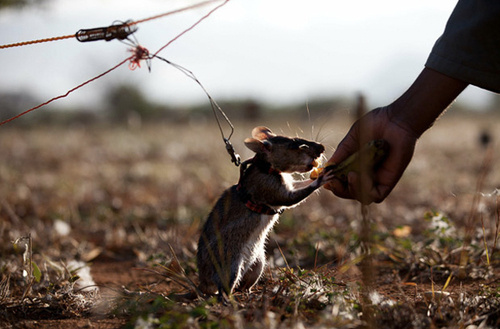
This is a great idea.  Dogs are used the same way, but are usually far too heavy and often quite fussy.  Rats are way more intense and focused without the suffering from the attachment to a human society that affects their wild behavior.

I suspect that the cost of cleaning up all the world’s mine fields just became completely doable as standard military practice without the need for the intense training we had in the past.  Or at least locating them just became easy.  We may still have to be fussy about removal though a flail on a beam on an armored truck appeals to me.

From the description, it should be possible to set up on a known mine field and to actually clear the whole site with a number of rat packs in an afternoon.  Again this is almost within the parameters of a training exercise with lots of red ribbon.

Mines are the big problem, but using rats for disease testing takes another known protocol and makes it available in any lab.  After all, labs are already used to working with rats and it is not necessary to take the rat home with you when the shift is over.  Thus we can process vast amounts of test material before the hard part of confirmation takes place.

Sniffer 'hero rats' saving lives in minefields and labs

By Otto Bakano (AFP) – 2 days ago


MOROGORO, Tanzania — A baby rat in a tiny red and black harness twitches its pointed nose incessantly, probing a grassy field where it is being trained by a pioneering Belgian NGO to smell out deadly landmines.

Other rats trained under the same scheme have already helped clear large swathes of land in neighbouring mine-infested Mozambique.

Babette, the two-month-old baby, walks unsteadily across the weedy patch followed by two trainers rolling a bar that teaches her to go back and forth across the patch in straight lines.

Light, with an acute sense of smell and easily motivated by food rewards, giant African pouched rats have been found to be highly effective in mine detection by APOPO, the Belgian non-governmental organisation that launched the training project -- the first of its kind -- in this Tanzanian town.

The rodents are trained to detect the TNT in landmines through operant conditioning: a click sound to signal a food reward whenever they make the correct detection.

Other rats in the same project undergo a different type of training -- they learn to sniff out tuberculosis in laboratory sputum samples, providing a second-line screening for hospitals in Tanzania where lab testing has 60 percent accuracy.

Training begins at four weeks old when the baby rats are exposed to humans and new surroundings, after which they are taught to associate a click sound with food.

Once that is achieved, they are then trained to distinguish TNT scent from other smells.

When they successfully distinguish it, the click is sounded and they are given a bit of banana, thus reinforcing the link between positive TNT identification and food.

In all, it takes nine months of painstaking on- and off-field training for a rat to be deployed for mine detection.

"This work is not easy," recounts trainer Abdullah Mchomvu, holding a rat cage under his left arm. "You have to be patient. Sometimes I get frustrated, but then again I tell myself these are animals."

But "this work saves lives," he added.

It takes two deminers a day to clear a 200 square-metre (2,150 square-feet) minefield, but if they work with two rats they can sweep it in two hours.


"Detection is the most difficult, dangerous and expensive part of mine action. Since rats are much easier to train than dogs, rats in this environment are much more appropriate," said Bart Weetjens, the founder of APOPO.

"They are very effective. We have very high success rates. So far they have helped re-open almost two million square metres of land" in Mozambique.

In the lab, the rats use their keen noses to positively identify tuberculosis sputum samples.

Ten samples are slotted into the bottom portion of a long rectangular glass cage containing one trained rat. The animal sniffs each sample and scratches intently over any suspect sample, with a laboratory technician looking on and taking notes.

It takes a fully trained rat less that 10 minutes to sniff through 70 samples with high accuracy. Samples found negative for tuberculosis by the hospitals are at times proven positive by the rats and a second lab testing.

"In hospitals we work with, we have increased their detection rate by about 40 percent," said Dian Kuipers, a lab supervisor with APOPO.

Kuipers explained that in September alone they found 69 positive tuberculosis samples that were missed by hospitals and since the programme started three years ago more than 1,500 TB infections initially missed by microscopes have been detected with the help of the rats.

"You have to be pretty sick for the bacteria to be detected" in hospital laboratories, she said.

Tuberculosis is the deadliest opportunistic disease among HIV patients. In Tanzania, less than half of people with active TB are diagnosed before they die and every undetected case cause infections to up to 15 people every year.

However, rats here are seen as vermin that spread disease and destroy harvests.

"Rats absolutely have an image problem. People don't like them and that is one of our biggest struggles," said Weetjens.

"We are trying to change that perception. Rats are very sociable, very intelligent highly likeable creatures."

APOPO calls its sniffers "hero rats" in recognition of the work they perform.

The organisation's website pictures rats that could be straight out of Beatrix Potter: all pink noses and quivering whiskers.

APOPO has even launched an Adopt-a-Rat scheme where individuals and corporations can contribute to the upkeep and the training of a sniffer rat, receiving in exchange an adoption certificate and email updates on the animal's training or career.

Weetjens said the next frontier would be to use the "hero rats" to sniff out narcotics or to search for survivors of disasters such as earthquakes or collapsed buildings.


  • Digg
  • Del.icio.us
  • StumbleUpon
  • Reddit
  • RSS

Graphene Gets A Teflon Makeover


I must admit that I am no fan of Teflon cook ware.  Any that I was ever given soon got ruined and had to be thrown out.  I much prefer my cast iron pan which is naturally surfaced with elemental carbon that I have owned and used every day since 1972.  Every other pan eventually succumbs to etching somehow as the alloy is never reaction proof.

This bit of work may actually give us what I certainly want to see.  A surface of elemental carbon in the form of graphene will prevent etching and the Teflon may maintain the bond with the underlying metal.  It just may work for that light weight stainless steel or aluminum pan.

Otherwise this is also a powerful proof of concept.  We can produce a sheet of graphene and then react one side of it to form a alternative surface.  There will be plenty of options and curious applications as we let our imaginations run wild.

For starters it produces a working substrate that allows large sheets of graphene to be managed properly.  Thus body armor just became feasible.

I suspect we are also talking of full body armor that covers limbs and all.


Graphene Gets A Teflon Makeover
by Staff Writers

Manchester, UK (SPX) Nov 09, 2010


Graphane crystal. This novel two-dimensional material is obtained from graphene (a monolayer of carbon atoms) by attaching hydrogen atoms (red) to each carbon atoms (blue) in the crystal.


University of Manchester scientists have created a new material which could replace or compete with Teflon in thousands of everyday applications.

Professor Andre Geim, who along with his colleague Professor Kostya Novoselov won the 2010 Nobel Prize for graphene - the world's thinnest material, has now modified it to make fluorographene - a one-molecule-thick material chemically similar to Teflon.

Fluorographene is fully-fluorinated graphene and is basically a two-dimensional version of Teflon, showing similar properties including chemical inertness and thermal stability.

The results are this week reported in the advanced online issue of the journal Small. The work is a large international effort and involved research groups from China, the Netherlands, Poland and Russia.

The team hope that fluorographene, which is a flat, crystal version of Teflon and is mechanically as strong as graphene, could be used as a thinner, lighter version of Teflon, but could also be in electronics, such as for new types of LED devices.

Graphene, a one-atom-thick material that demonstrates a huge range of unusual and unique properties, has been at the centre of attention since groundbreaking research carried out at The University of Manchester six years ago.

Its potential is almost endless - from ultrafast transistors just one atom thick to sensors that can detect just a single molecule of a toxic gas and even to replace carbon fibres in high performance materials that are used to build aircraft.

Professor Geim and his team have exploited a new perspective on graphene by considering it as a gigantic molecule that, like any other molecule, can be modified in chemical reactions.

Teflon is a fully-fluorinated chain of carbon atoms. These long molecules bound together make the polymer material that is used in a variety of applications including non-sticky cooking pans.

The Manchester team managed to attach fluorine to each carbon atom of graphene..

To get fluorographene, the Manchester researchers first obtained graphene as individual crystals and then fluorinated it by using atomic fluorine.

To demonstrate that it is possible to obtain fluorographene in industrial quantities, the researchers also fluorinated graphene powder and obtained fluorographene paper.

Fluorographene turned out to be a high-quality insulator which does not react with other chemicals and can sustain high temperatures even in air.

One of the most intense directions in graphene research has been to open a gap in graphene's electronic spectrum, that is, to make a semiconductorout of metallic graphene. This should allow many applications in electronics. Fluorographene is found to be a wide gap semiconductor and is optically transparent for visible light, unlike graphene that is a semimetal.

Professor Geim said: "Electronic quality of fluorographene has to be improved before speaking about applications in electronics but other applications are there up for grabs."

Rahul Nair, who led this research for the last two years and is a PhDstudent working with Professor Geim, added: "Properties of fluorographene are remarkably similar to those of Teflon but this is not a plastic.

"It is essentially a perfect one-molecule-thick crystal and, similar to its parent, fluorographene is also mechanically strong. This makes a big difference for possible applications.

"We plan to use fluorographene an ultra-thin tunnel barrier for development of light-emitting devices and diodes.

"More mundane uses can be everywhere Teflon is currently used, as an ultra-thin protective coating, or as a filler for composite materials if one needs to retain the mechanical strength of graphene but avoid any electrical conductivity or optical opacity of a composite".

Industrial scale production of fluorographene is not seen as a problem as it would involve following the same steps as mass production of graphene.

The Manchester researchers believe that the next important step is to make proof-of-concept devices and demonstrate various applications of fluorographene.

Professor Geim added: "There is no point in using it just as a substitute for Teflon. The mix of the incredible properties of graphene and Teflon is so inviting that you do not need to stretch your imagination to think of applications for the two-dimensional Teflon. The challenge is to exploit this uniqueness."

  • Digg
  • Del.icio.us
  • StumbleUpon
  • Reddit
  • RSS

Smaller Is Better In The Viscous Zone


I am not sure how this is news.  Twenty years ago, in order to make a large molecule suspension react better, we used micron based elemental carbon to grab the molecules and separate them from others in suspension.  It worked very well.

The work on micron sized elemental carbon had been derived from work aimed at producing a blood replacement a generation earlier.

Of course particle size matters and far more than is imagined.  The empirical work on gold particles has slowly created smaller and smaller sized particles of gold.  This has shown in various forms and in odd papers and is about to become extremely important because a suspension of twenty nanometer gold in able to selectively penetrate cancer cells and heat up under radio wave treatment to outright destroy the cells.

Producing the desired size is normally the difficulty and this paper is suggesting another avenue.


Smaller Is Better In The Viscous Zone

by Staff Writers
Durham NC (SPX) Oct 28, 2010

It is estimated that more than 90 percent of chemical processes used by industry involve catalysts at some point.


Being the right size and existing in the limbo between a solid and a liquid state appear to be the secrets to improving the efficiency of chemical catalysts that can create better nanoparticles or more efficient energy sources.

When matter is in this transitional state, a catalyst can achieve its utmost potential with the right combination of catalyst particle size and temperature, according to a pair of Duke University researchers. A catalyst is an agent or chemical that facilitates a chemical reaction. It is estimated that more than 90 percent of chemical processes used by industry involve catalysts at some point.

This finding could have broad implications in almost every catalyst-based reaction, according to an engineer and a chemist at Duke who reported their findings on line in the American Chemical Society's journal ACS-NANO. The team found that the surface-to-volume ratio of the catalyst particle - its size - is more important than generally appreciated.

"We found that the smaller size of a catalyst will lead to a faster reaction than if the bulk, or larger, version of the same catalyst is used," said Stefano Curtarolo, associate professor in the Department of Mechanical Engineering and Materials Sciences.

"This is in addition to the usual excess of surface in the nanoparticles," said Curtarolo, who came up with the theoretical basis of the findings three years ago and saw them confirmed by a series of intricate experiments conducted by Jie Liu, Duke professor of chemistry.

"This opens up a whole new area of study, since the thermo-kinetic state of the catalyst has not before been considered an important factor," Curtarolo said. "It is on the face of it paradoxical. It's like saying if a car uses less gas (a smaller particle), it will go faster and further."

Their series of experiments were conducted using carbon nanotubes, and the scientists believe that same principles they described in the paper apply to all catalyst-driven processes.

Liu proved Curtarolo's hypothesis by developing a novel method for measuring not only the lengths of growing carbon nanotubes, but also their diameters. Nanotubes are microscopic "mesh-like" tubular structures that are used in hundreds of products, such as textiles, solar cells, transistors, pollution filters and body armor.

"Normally, nanotubes grow from a flat surface in an unorganized manner and look like a plate of spaghetti, so it is impossible to measure any individual tube," Liu said. "We were able to grow them in individual parallel strands, which permitted us to measure the rate of growth as well as the length of growth."

By growing these nanotubes using different catalyst particle sizes and at different temperatures, Liu was able to determine the "sweet spot" at which the nanotubes grew the fastest and longest. As it turned out, this happened when the particle was in its viscous state, and that smaller was better than larger, exactly as predicted before.

These measurements provided the experimental underpinning of Curtarolo's hypothesis that given a particular temperature, smaller nanoparticles are more effective and efficient per unit area than larger catalysts of the same type when they reside in that dimension between solid and liquid.

"Typically, in this field the experimental results come first, and the explanation comes later," Liu said. "In this case, which is unusual, we took the hypothesis and were able to develop a method to prove it correct in the laboratory."

The research was supported by the Office of Naval Research, the National Science Foundation, the Department of Energy and the National Council of Science and Technology (CONACYT), Mexico. Duke's Thomas McNicholas and Jay Simmons, as well as Felipe Cervantes-Sodi, Gabor Csanyi and Andrea Ferrari, University of Cambridge, U.K., were also members of the team.

  • Digg
  • Del.icio.us
  • StumbleUpon
  • Reddit
  • RSS